




Why AI is now core to running a scaled CPMS
There's a version of EV charging infrastructure management that most people still picture when they think of a charge point management system (CPMS). A dashboard, some maps, green dots for online, red dots for offline. Maybe a few alerts when something goes wrong. It's tidy, it's familiar, and it's increasingly not enough.
The reality of operating charge points at scale in 2026 looks nothing like that. On any given day, the platforms running behind the scenes are handling a constant stream of OCPP telemetry from hardware spanning multiple manufacturers, processing real-time payment authorisations across a patchwork of terminal providers and acquiring banks, managing roaming sessions through various (very inconsistently implemented) OCPI standards with partners who all have their own quirks and failure modes, all whilst working to keep thousands of connectors available for drivers who, quite reasonably, just expect things to work.
That's an operational intelligence problem. AI is becoming foundational to how charge point management systems need to evolve as a practical response to genuine operational complexity.
THe data was always there. the insight wasn't
Charge points have been generating enormous volumes of data for years. Every OCPP heartbeat, every status notification, every meter value, every transaction start and stop. The trouble is that most of this data has historically been logged and forgotten, or at best surfaced through static dashboards that tell you what happened after the fact.
What's changing is our collective ability to act on that data in real time. When you combine telemetry streams with payment processing data, roaming partner signals, energy market information and historical fault patterns, you gain genuine understanding of how your network behaves. You can begin to see that a particular charger model tends to throw a specific error before it drops offline entirely. You can spot that sessions from a specific roaming partner are failing at an unusually high rate, potentially before their own support team has noticed. You can identify that a payment terminal is returning authorisation failures in a pattern that suggests configuration drift rather than a hardware fault.
This is where the industry is heading, and the platforms that have invested early in these capabilities are already delivering meaningful operational advantages to their customers. At Fuuse, we've been building towards this for some time, and we're seeing the impact in how our platform helps CPOs identify and resolve issues before they affect drivers or revenue.
uptime is a revenue problem
Every minute a charger is offline, someone is losing money. The site host, the CPO, the network operator. In a market where utilisation rates are climbing and the sector is transitioning from a growth and land-grab phase towards one where early investors rightly expect a return, uptime isn't just an operational metric. It's a critical component of generating a positive ROI.
Traditional approaches to uptime management are reactive by nature. Something breaks, an alert fires, someone investigates, a field engineer gets dispatched. The cycle time from fault to fix can stretch into days, sometimes longer if parts need ordering or the root cause isn't immediately obvious. Multiply that across hundreds or thousands of charge points and you start to see where margin gets eroded.
AI enables predictive intervention. The goal is to identify early warning signs and act before the driver ever notices, instead of waiting for a charger to fail and then scrambling. That might mean remotely resetting a charge point exhibiting pre-fault behaviour, proactively flagging a payment terminal that needs reconfiguring, or routing a field engineer to a site before the charger actually goes offline. This is operational for us. The platforms that have built these capabilities are already helping CPOs protect revenue by keeping chargers available when drivers need them.
Payments and roaming add layers of complexity that demands intelligence
If charge point hardware was the only variable, this would be a simpler problem. Modern CPMS platforms sit at the intersection of data, infrastructure, energy, payments and mobility, with each of those domains bringing its own universe of complexity.
Payment processing in EV charging is genuinely tough. You're dealing with contactless terminals in outdoor environments, sometimes on unreliable network connections, handling pre-authorisation flows that need to work seamlessly even when a session is being routed through a roaming partner in another country. When a payment fails, the root cause could be the terminal hardware, the network, the acquiring bank, the roaming platform, or a combination thereof. Diagnosing that quickly requires the kind of pattern recognition that AI is well suited to. Equally, reconciling increasing volumes of transactions across a broad array of payment methods and solution providers is a challenge that shouldn't be underestimated. At scale, it's simply not feasible without intelligent automation.
Roaming through OCPI adds another dimension entirely. Every partner integration behaves slightly differently. Session data needs to be synchronised accurately for billing. Location data needs pushing reliably so drivers see correct availability in whichever app they're using. When something goes wrong in the roaming chain, the debugging process without intelligent tooling is impossible. With it, you can begin to isolate failure points in minutes instead of hours.
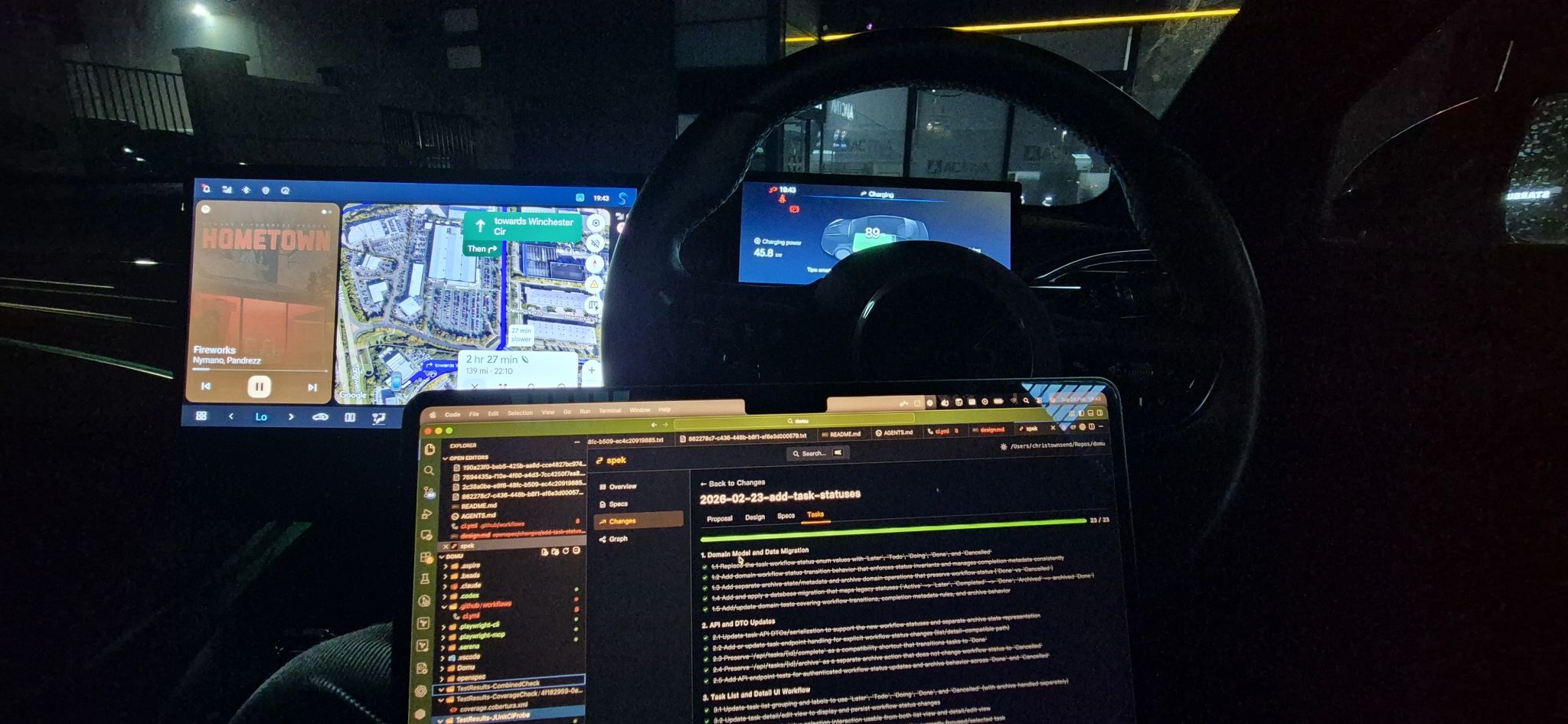 Photo: Fuuse Technology Director, Chris Townsend putting learnings into action while charging en route home from the Microsoft AI Summit.
The charge point is just the beginning
The industry tends to talk about charge points as if they're the product. In my view, they're simply nodes in an increasingly complex energy and mobility network. The real value, for CPOs, for fleets, for site hosts, for drivers, sits in the invisible intelligence layer that makes that network reliable, efficient and commercially viable.
That's the shift happening right now across the industry. From charge points to intelligent infrastructure. For CPOs operating at scale, the question is which platforms have invested in building it properly and which are best positioned to support what comes next. At Fuuse, we've made our choice, and we're already seeing the results in the networks we support. We have a long way to go to realise our full ambition, but our team knows where we are going and how to get there.
Find out more
If any of this resonates, or if you see things differently, I'd genuinely welcome the conversation. You can find me on LinkedIn or reach out to the Fuuse team directly if you'd like to explore how we can support your network as it grows. We're always happy to talk.