

Dynamic Load Balancing
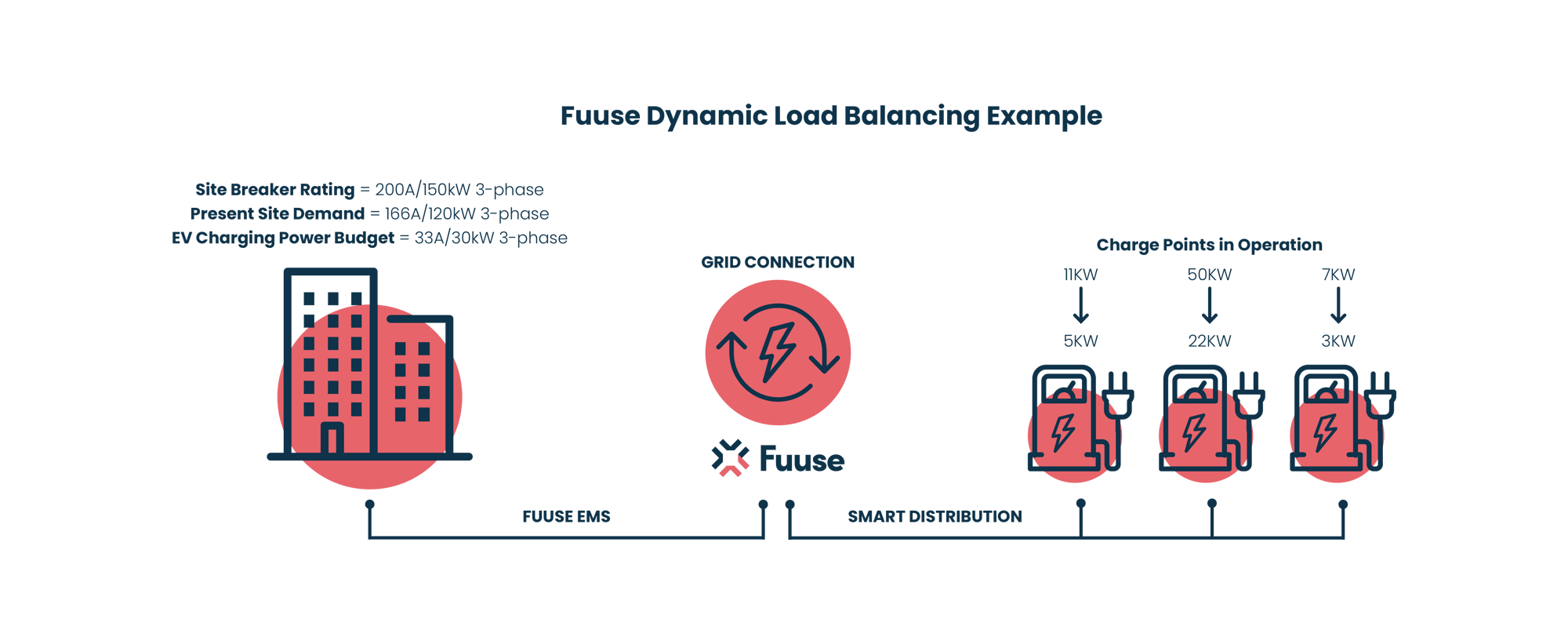
Dynamic Load Balancing (DLB) for sites with more complex energy demands - keeps chargers running at maximum possible power in real-time while protecting your site from power outages and your DNO contracted capacity.
static load balancing
Static Load Balancing (SLB) for smaller sites with more predictable demand - sets a fixed, predetermined amount of power for EV chargers. SLB is lower cost but suited to less complex, more predictable sites..
Dynamic load balancing (DLB)
DLB works to maximise your existing infrastructure and the power available to your site. This allows more vehicles to charge simultaneously while reducing the need for costly grid upgrades. EV charging at fleet depots, workplaces or residential complexes often occurs at peak demand times. This can result in unbalanced power distribution between vehicles, leaving some without adequate charge. DLB monitors the site demand in Amps and Kva in real-time, automatically allocating power proportionally between charging EV’s if user thresholds are breached. DLB works alongside Dynamic Load Management (DLM) for full site energy optimisation. Choose DLB from Fuuse to:
- Avoid or defer grid upgrades: Push existing connections safely to their limit and avoid or defer costly grid upgrades such as new transformers, cabling, and switchgear. Add more chargers without the disruption of digging up areas of the site.
- Maximise charging through the same breaker: Dynamic real-time power allocation replaces fixed static limits so chargers ramp up when building load is low (nights and weekends) and automatically back off when demand spikes. It’s simply smarter use of your grid connection.
- Operate at scale with centralised control across multiple sites: The Fuuse Energy platform can scale smoothly from a single site to hundreds, giving you visibility from just one dashboard. This displays real-time load visibility, historic and live demand and consumption charger, while alerting you to overloads, offline units, or comms failures.
- Enable fleet, staff and public charging on one site: Set clear priorities (for example Fleet first, then staff, then guests) so that when the site is overloaded, critical sessions are prioritised. This means everyone can still plug in, but your key users won’t get stranded.
How does dynamic load Balancing work?
Proportional power allocation
Automatic adjustments

Energy demand measured

Dashboard insights

Static load balancing (SLB)
Static Load Balancing (SLB) is well suited to smaller non-domestic sites where energy availability is consistent and demand is predictable. It provides a simple, cost-effective way to manage EV charging loads without the complexity of real-time control, and can act as a practical first step before upgrading to dynamic solutions if power demand grows. Choose SLB from Fuuse for:
- Simple, low cost deployment: SLB is straightforward to install and operate, with minimal infrastructure changes required. This makes it ideal for sites with limited budgets or straight forward electrical environments.
- Consistent, predictable charging: Deliver a stable and reliable charging experience, as each charger operates within a fixed, pre-defined power limit. By design, this reduces the risk of exceeding site capacity and helps protect the electrical connection.
- Low operational complexity: Keep day-to-day operations simple and and maintenance requirements light with no continuous monitoring or real-time adjustments needed.
- Future ready and scalable: SLB provides a solid foundation for growth. As charging demand increases or site conditions change, systems can be upgraded to DLM or Dynamic Load Management (DLM).
How does Static load balancing work?
Pre-fixed power allocation
Predictable charging rates
Dashboard Visibility
Why Choose Load Balancing solutions from Fuuse?
Scalable solutions for different site types
Fuuse load balancing solutions are designed to evolve with your site. You can begin with SLB for straightforward installations and move to DLB as energy demands become more complex.
Part of a complete energy management approach
SLB and DLB integrate with Fuuse Dynamic Load Management, enabling broader site-wide energy optimisation, rather than treating EV charging in isolation. Find out more about DLM.
Insight-driven decision making
The Fuuse Energy Monitoring platform provides detailed reporting and real-time visibility, allowing you to identify usage patterns, understand peak demand, and plan infrastructure upgrades with confidence.
Proactive alerts
Receive automated alerts when site limits or thresholds are reached, enabling you to respond quickly and reduce the risk of disruption.

Dynamic vs Static - which package to start with?
Dynamic Load Balancing
-
Designed for larger, more complex sites
-
Works for environments where energy fluctuates throughout the day
-
Enables higher charger density - Better utilisation of existing grid connections
-
Greater future resilience
Static load balancing
-
Best suited to smaller, simpler sites
-
Works best for stable, predictable energy profiles
-
Easy to deploy and operate but cannot respond to changes in building load
-
Spare capacity can go unused in quiet periods
For more insight into DLB and SLB, and to decide which energy package suits your site and requirements, complete the form below. One of our energy experts will be in touch.